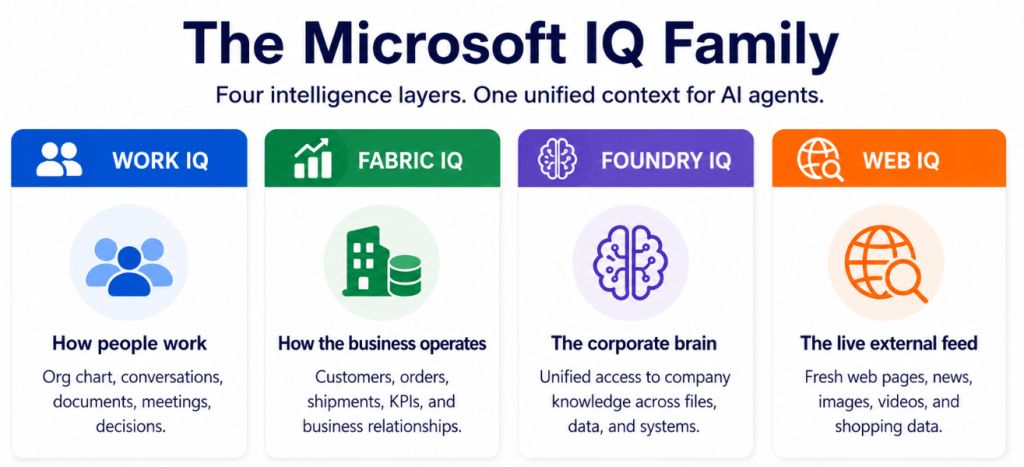
If you’ve followed Microsoft Build 2026, you’ve probably heard the term “Microsoft IQ” thrown around a lot. Four flavors of it, actually: Work IQ, Fabric IQ, Foundry IQ, and Web IQ. Microsoft positions them as the shared intelligence layer for AI agents — but the documentation can feel dense, and most people walk away unsure which IQ does what.
This article breaks it with a real-world example at the end.
Why IQ matters in the first place
Before IQ, building an enterprise AI agent meant stitching things together yourself: connecting to SharePoint, indexing documents, building a RAG pipeline, plugging in business metrics from one system, then bolting on web search. Every team rebuilt the same plumbing.
Microsoft IQ is the company’s answer to that mess. It’s a unified context layer — four interconnected services that ground your agents in different kinds of knowledge, so you don’t have to wire them up yourself.
Think of it as four lenses through which your agent can look at the world.
The four IQs at a glance
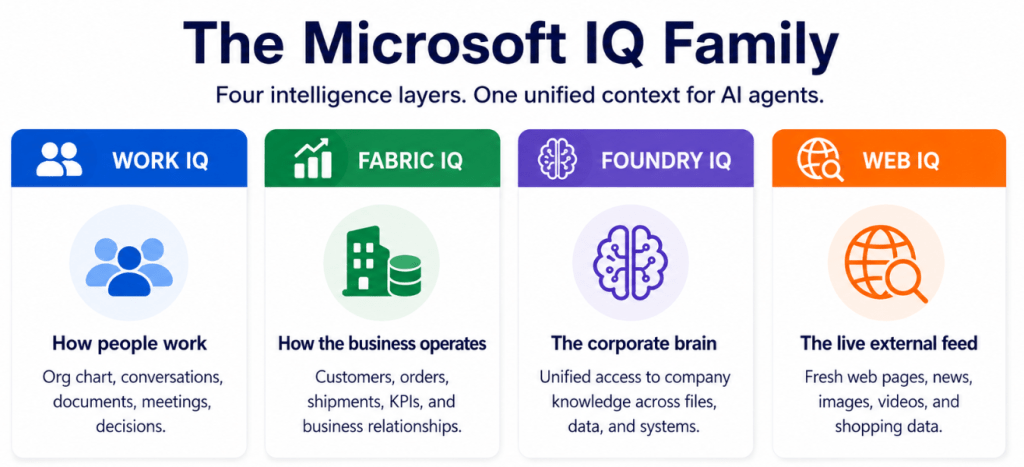
| IQ | What it knows | One-liner |
|---|---|---|
| Work IQ | How people work | The org chart, in motion |
| Fabric IQ | How the business operates | The business model, in data |
| Foundry IQ | What the company knows | The corporate brain |
| Web IQ | What’s happening outside | The live external feed |
Now let’s unpack each one.
Work IQ — how people actually work
Work IQ captures how work happens across Microsoft 365: who talks to whom, which documents matter, which meetings led to which decisions, how teams collaborate. It builds a continuously updated semantic view of your organization’s people, content, and workflows.
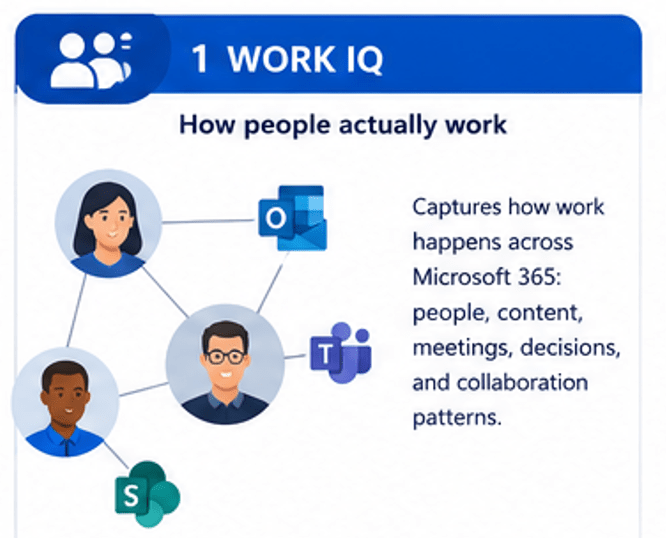
When your agent needs to know “who’s the right person to approve this expense?” or “what did the leadership team agree on in last Tuesday’s review?”, Work IQ is the layer that answers.
Fabric IQ — how the business operates
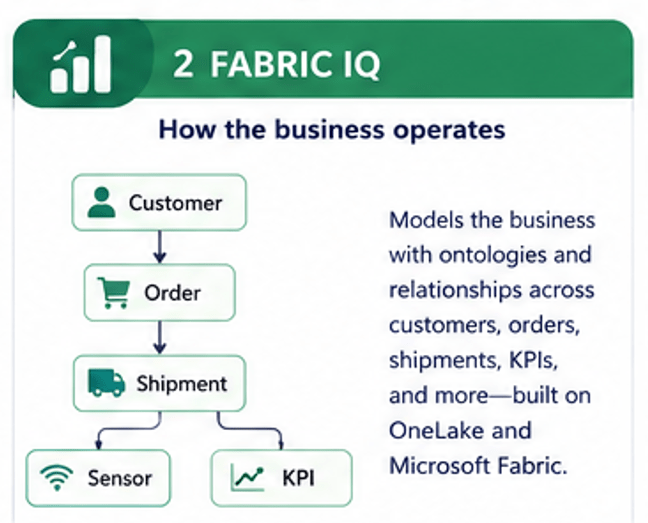
Where Work IQ models people and collaboration, Fabric IQ models the business itself: customers, orders, shipments, KPIs, and the relationships between them. It’s built on OneLake and sits on top of Microsoft Fabric’s data estate.
The key concept here is ontology (currently in preview): a formal definition of business entities and how they connect. Instead of an agent guessing what “customer churn” means at your company, Fabric IQ tells it — based on definitions your data team already curated.
This is what makes cross-domain reasoning possible. An agent can traverse a chain like Order → Shipment → Temperature Sensor → Cold Chain Breach and actually explain a business outcome, because the relationships are explicit.
If you’ve ever watched a copilot give a confidently wrong answer about your company’s metrics, Fabric IQ is what fixes that.
Foundry IQ — the corporate brain
Foundry IQ is the knowledge layer for agents built in Azure AI Foundry. Its job is to replace the custom RAG pipeline you’d otherwise build by hand.
It unifies multiple knowledge sources behind a single SLA-backed retrieval endpoint:
- Work IQ (Microsoft 365 content)
- Fabric IQ (business data and ontology)
- File Search (uploaded documents)
- Azure SQL (structured relational data)
- MCP sources (anything that speaks Model Context Protocol)
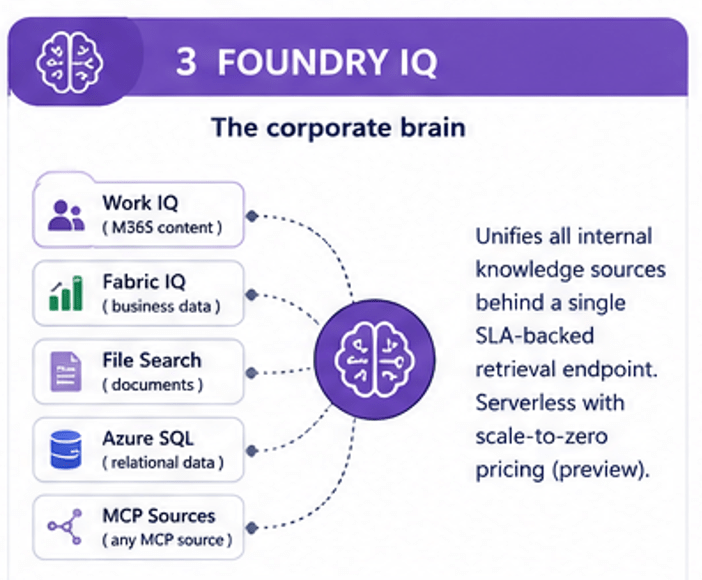
It’s also serverless now, with scale-to-zero pricing in preview. For developers, the practical benefit is enormous: no more chunking strategies, no more vector store maintenance, no more reconciling five different retrieval systems. You point Foundry IQ at your sources, and your agent gets one clean knowledge interface.
If Work IQ and Fabric IQ are what the company knows, Foundry IQ is how agents access it.
Web IQ — the live external feed
Web IQ is the newest addition, announced at Build 2026. It gives agents access to fresh, real-world information from across the web: pages, news, images, videos, and shopping data. It’s built on nearly two decades of Bing search infrastructure.
Web IQ solves two problems no model can fix alone:
- Knowledge cutoffs. LLMs only know what they were trained on. Web IQ keeps them current.
- Verification. When an answer needs corroboration from independent sources, Web IQ provides it.
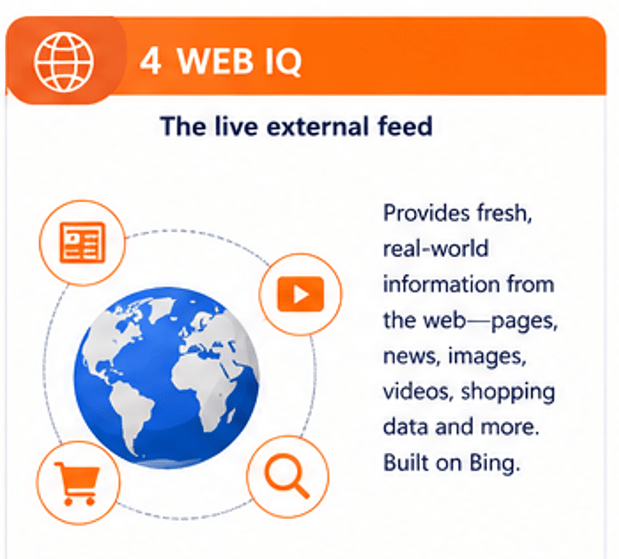
It’s available in limited preview through the Foundry IQ MCP knowledge source.
How they stack: a concrete example
Imagine a CIO planning a company-wide laptop refresh. A single agent powered by all four IQs can reason like this:
- Web IQ surfaces what’s currently sold, supported, and reviewed in the market.
- Fabric IQ catalogs which laptops are deployed today, by region and department.
- Work IQ shows how heavily employees actually use them — battery patterns, meeting load, travel frequency.
- Foundry IQ retrieves the company’s IT procurement policy and last year’s RFP.
Stacked together, those four layers turn what would have been a months-long analyst project into a single agent query. That’s the agentic web Microsoft has been pitching.

 Jihane Lazrag's blog
Leave a comment